Make your competency model actionable
Choose competencies for the whole organization or by job family. Career Bird suggests the levels and behaviors.
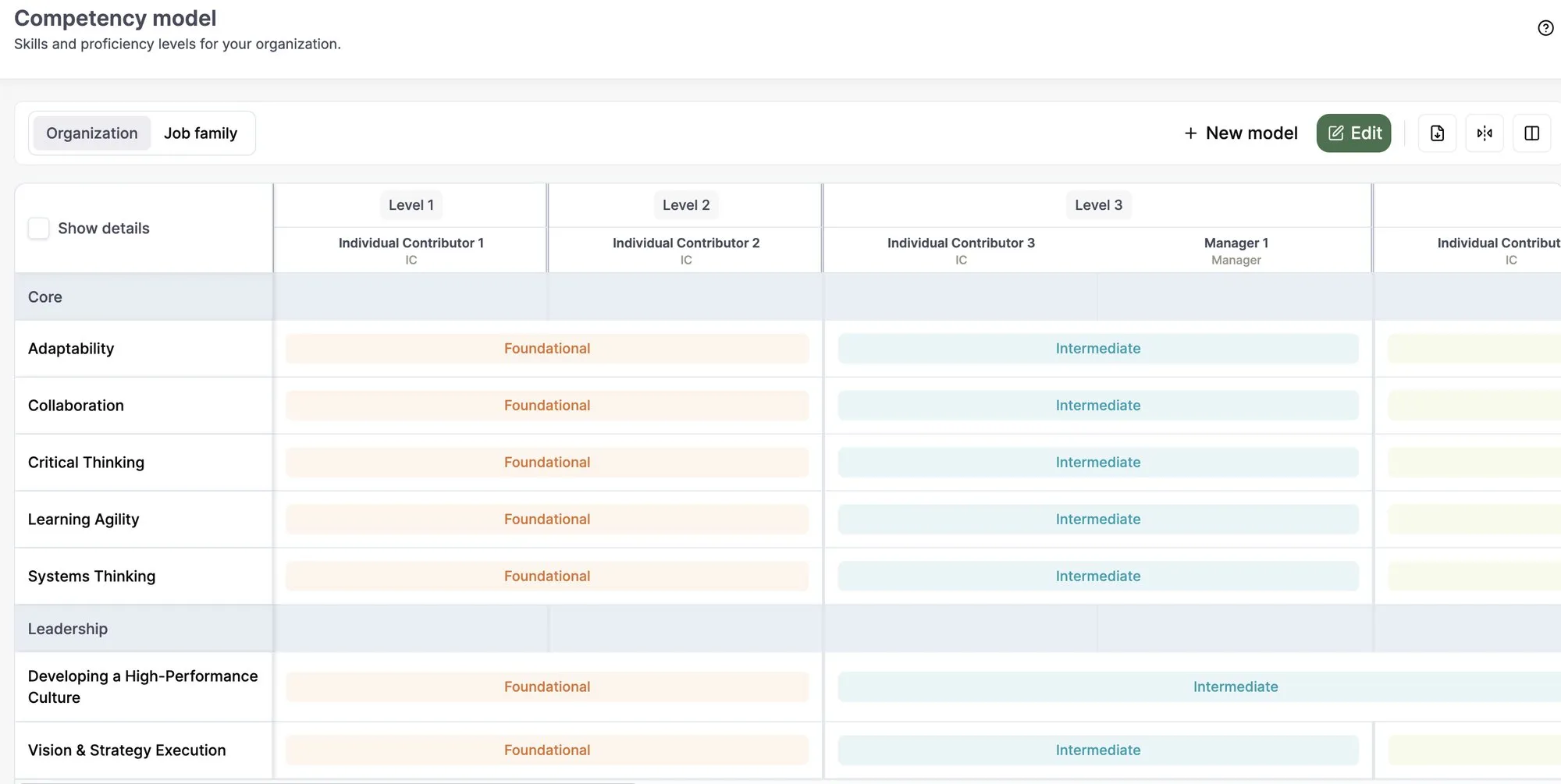
Create a competency model in weeks, not months
Your team picks the competencies. Career Bird suggests the levels and behaviors.






A competency model works when it is built into every role.
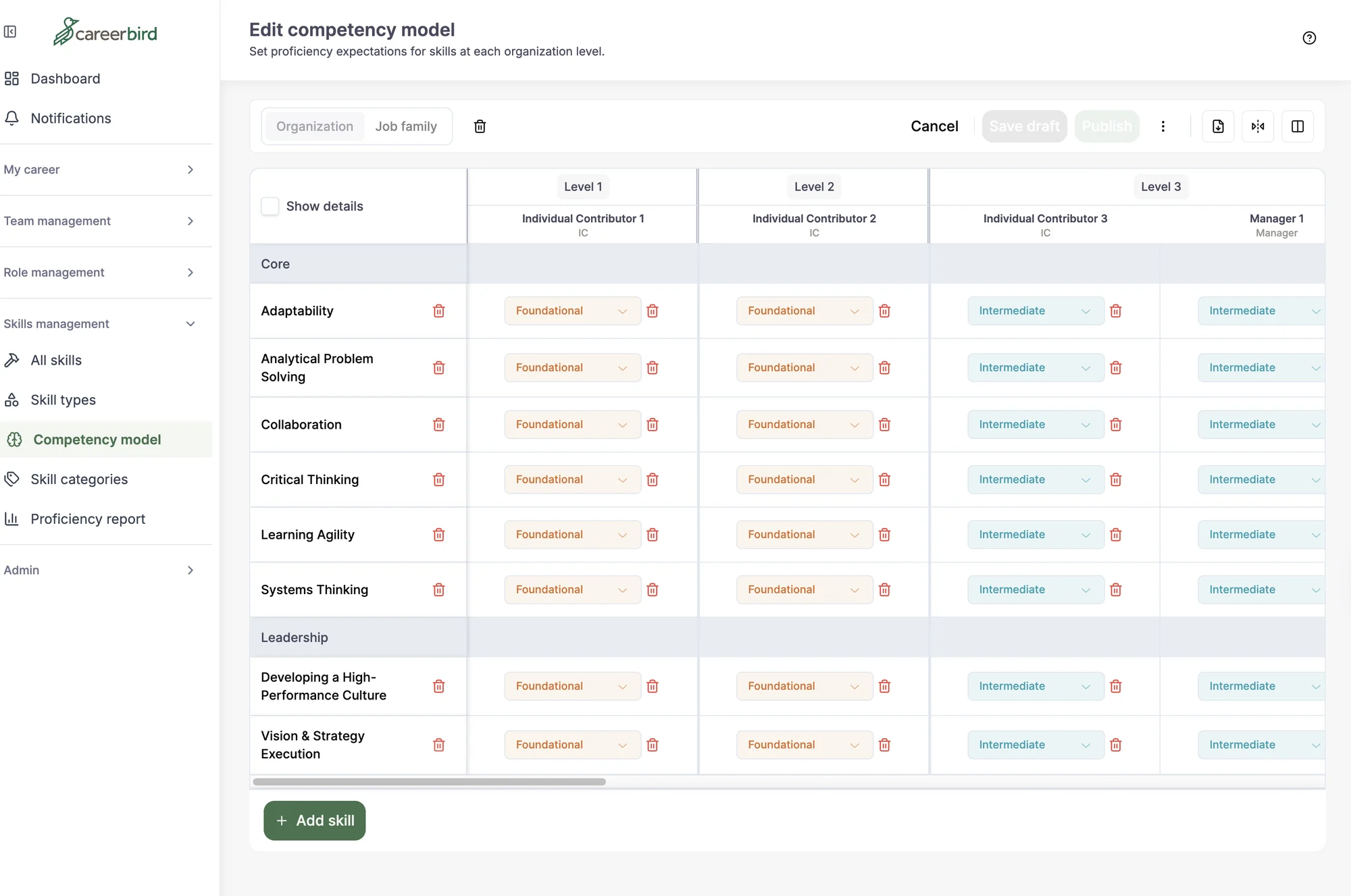
Define competencies once for every role
- Set competencies at the organization and job-family level.
- Extend them where a job family needs its own, such as engineering or sales.
- Add custom competency types, such as manager competencies or AI competencies.
- Change a definition once and every role that uses it follows.
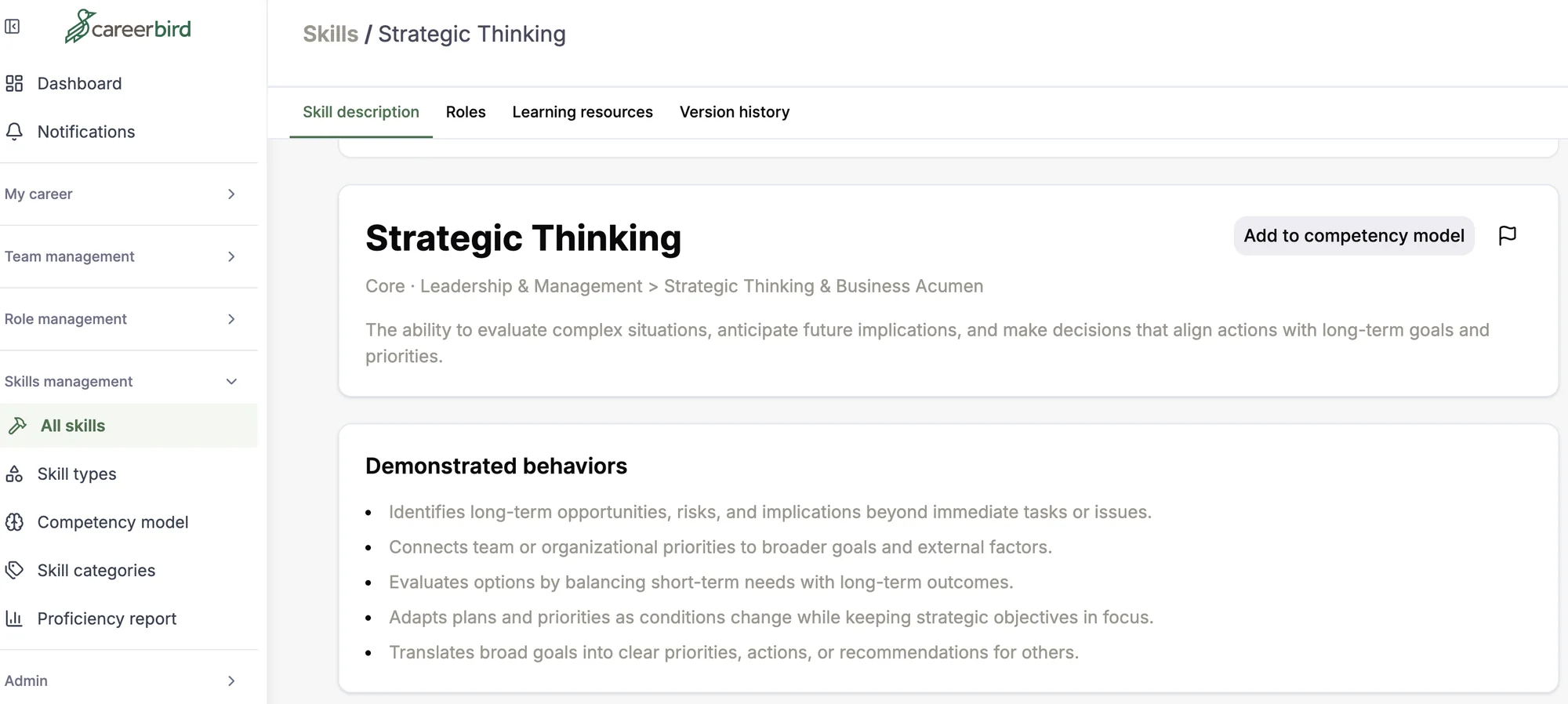
Demonstrated behaviors at each level
- Career Bird suggests the demonstrated behaviors for each competency.
- Employees can see what good looks like at the next level.
- Ratings become a conversation about behavior, not opinion.
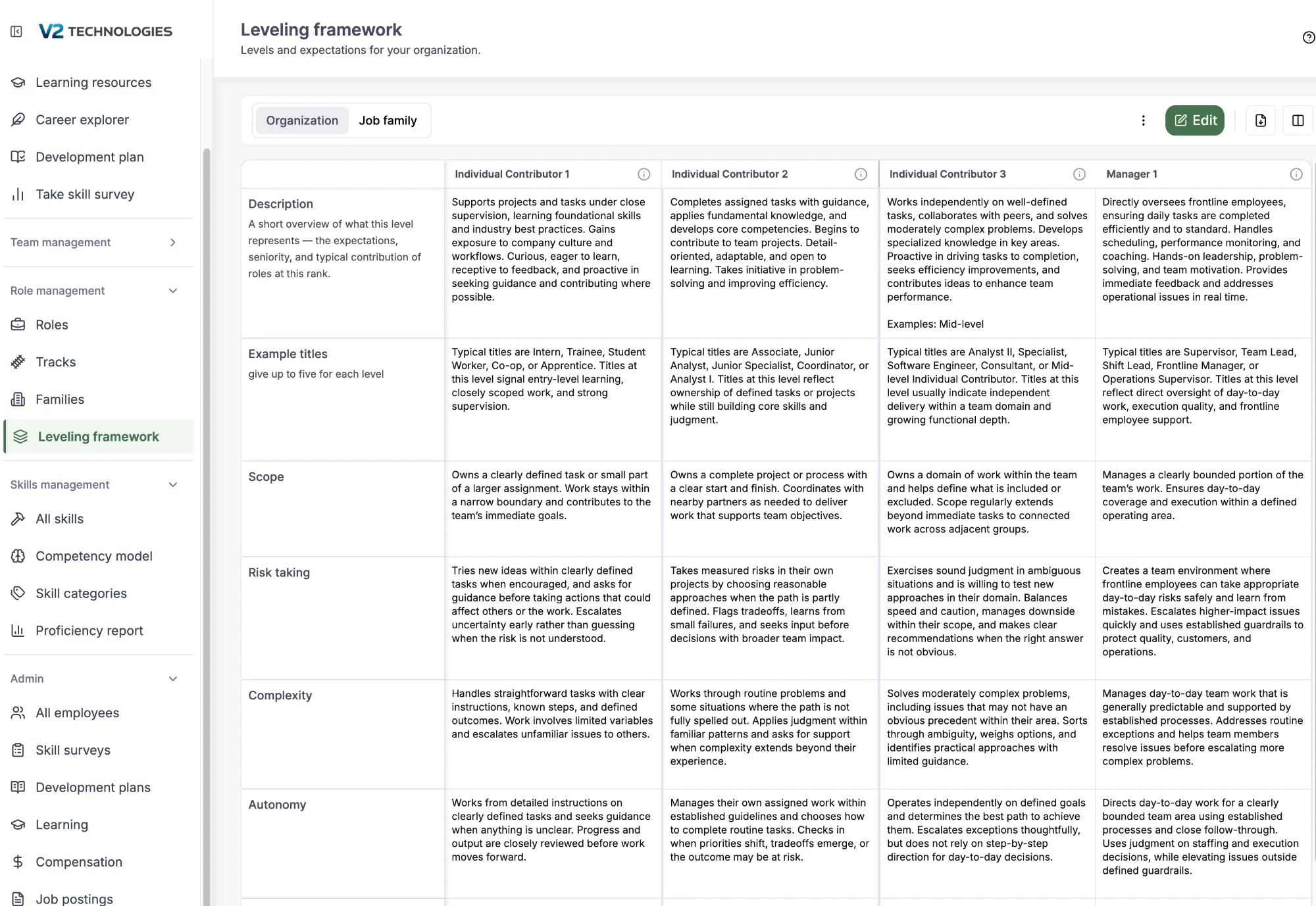
Connect competencies to your leveling framework
- Competencies and levels are two views of the same structure.
- Each level states the competencies it requires.
- Promotion criteria come from one definition.
Put the model to work for managers and employees
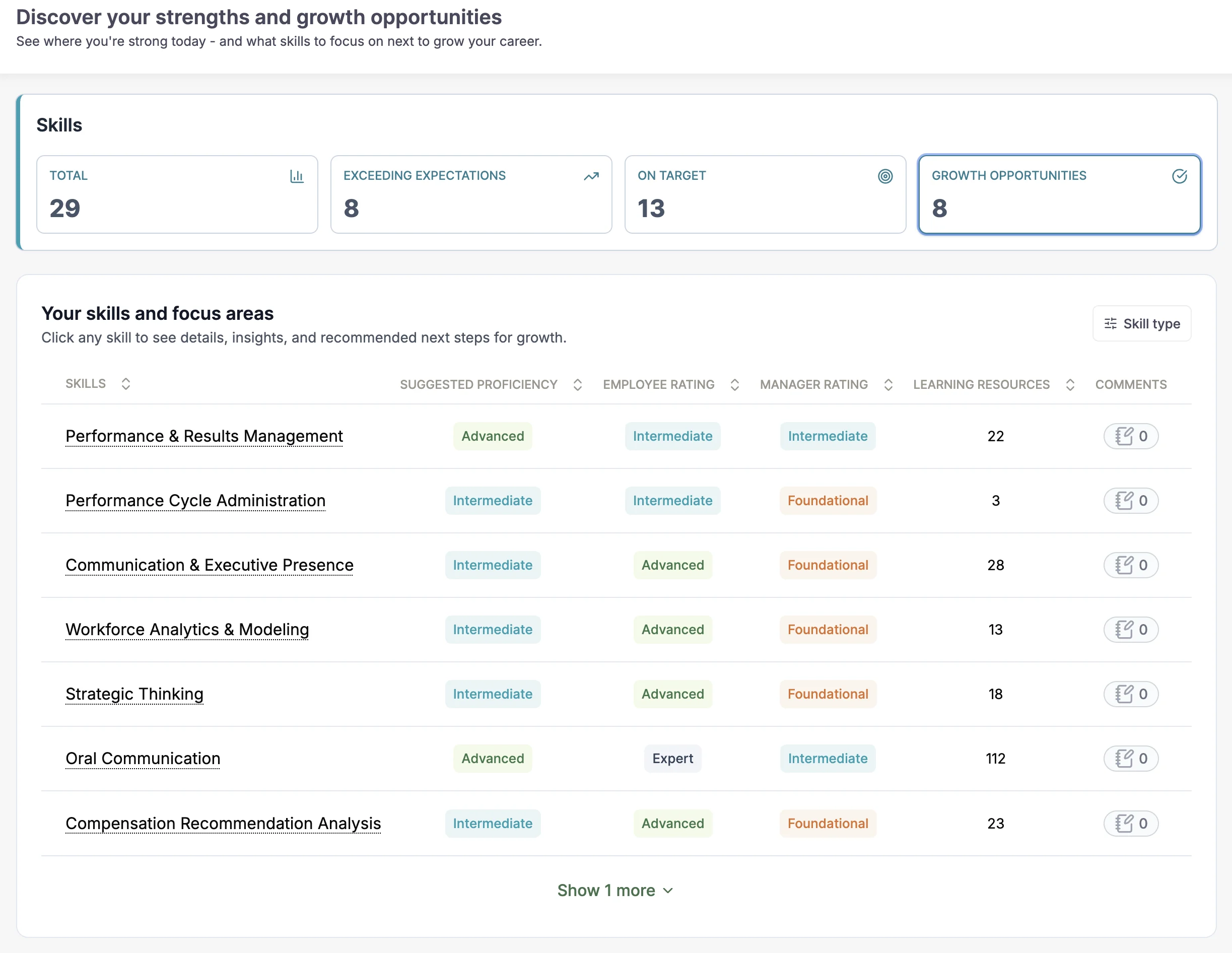
- Managers use it in development conversations.
- Employees use it to see what their next level requires.
- Updates are reflected immediately across all roles.
“I’ve followed Career Bird’s evolution from the start, and it’s clear this platform was built by people who truly understand how organizations and talent grow. What stands out most is how Career Bird makes skills the common language across job design, learning, and mobility.”
 Don CarterEVP of People & Culture, Kiva
“What impressed me most is the depth. It’s not just a checklist of features — there’s a real understanding of how organizations evolve, how skills shift, and how people learn and grow in their careers.”
 Heather VeldmanVP of Total Rewards, Go Health
“You can tell Career Bird wasn’t just thrown together by software engineers. It’s clear that IO psychologists and HR leaders played a significant role in developing it — the frameworks are thoughtful, practical, and grounded in science.”
 Kira MeinzerChief People Officer, Envoy Global
“Career Bird connects the dots between job design, skills, learning, and mobility. Instead of separate systems and spreadsheets, we now have a single platform that ties everything together.”
 Gail RodmanVP Talent Strategy & People Experience, Unite Us
“So many platforms claim to be skills-focused, but Career Bird is actually built that way. It treats skills as the foundation for job design, learning, and career paths. That matters right now because AI is rewriting roles faster than most companies can respond.”
 Ted EmersonVP, Head of People
“Career Bird is one of the few HR platforms that feels like it was built for the end-user. Teams won’t need a lengthy rollout or training — it’s intuitive, clear, and something managers and employees actually want to use.”
 Maureen CalabreseFormer Chief People Officer, Sprout Social and Modern Health
“Career Bird helps companies prepare for the future by turning skills data into human growth, organizational agility, and real impact.”
 Rishad TobaccowalaFormer Chief Strategist and Growth Officer, Publicis Groupe
“Career Bird was selected to participate in the competitive PeopleTech Partners Growth Program as they are building meaningful solutions for Talent and People Leaders aligned with what’s next in work.”
 Cara Brennan AllamanoFounding Partner, PeopleTech Partners
Fits the HR stack you already run
Career Bird pulls employee data from your HRIS and sends job descriptions to your ATS. Your HRIS stays the system of record for people; Career Bird for roles and skills.


 +150 more
Built for employee data
SOC 2 Type II audited, with a GDPR-aligned data processing agreement and role-based access for every user. Your data is never used to train AI models.
Questions buyers ask
Do we need one model for the whole company?
Career Bird supports one organization-level competency model, and/or job family specific competencies when a family needs its own. Organization-wide competencies usually cover core skills, sometimes called durable or soft skills, such as communication, collaboration, and judgment, which apply to every role. Job family competencies often cover role-based skills, sometimes called technical or functional skills, specific to that family's work. Both are defined once, with proficiency levels, so "proficient" means the same thing everywhere.
How is this different from a competency framework in a deck?
Unlike a competency framework in a deck, the competency model in Career Bird is connected. Competencies apply to roles, levels and development plans, so they are used in daily decisions rather than presented once.
Who can see the competency model?
Admins can see and edit the full model, including the company-wide competencies. Job family owners can view the full model but only edit the job family specific competency model. Managers and reviewers see the model for the roles they work with. Employees see the skills for their own role, and with Career Explorer turned on, their current level and the next two.
Can we use our existing competency model?
Yes, you can bring your existing competency model, and it becomes the starting point, the same way your existing job descriptions do.
What is a competency model?
A competency model defines the skills and behaviors expected at each level, with proficiency levels that describe what each looks like in practice. In Career Bird it is connected to every role and level.
How do you create a competency model?
Your team picks the competencies, for the whole organization or by job family. Career Bird suggests the proficiency levels and demonstrated behaviors for each one, and your team edits them before they are published.
What is the difference between a competency model and a competency framework?
The terms are often used interchangeably. A framework usually means the full set of competencies for the organization; a model can be the set applied to a role or job family. Career Bird handles both.
Can we include leadership competencies?
Yes. Leadership is one of the default skill types, and you can create your own, such as managerial competencies.
See a competency model built from your roles.
Upload a few job descriptions or the model you have today. Choose your competencies, and Career Bird suggests the levels and behaviors.