Develop and retain top talent with skills-based career frameworks
Use existing job descriptions to build a job and skills architecture that stays up to date.
A skills-based job architecture in weeks, not months
No consultants or spreadsheets. Managers keep their roles up to date, and HR approves every change.






The four problems we hear most from HR leaders.
“Roles and titles are changing fast, and we have no system to keep up.”
One system to manage roles, titles and skills, and organize them into a job architecture with levels, families and tracks.
“There is no centralized skills inventory, and we can’t measure gaps or plan training.”
A skills inventory built from employee and manager surveys, measured against the skills each role requires.
“Engagement with learning is low, and what we offer is expensive and ineffective.”
Development plans built on learning in the flow of work, each mapped to relevant learning resources and a mentor.
“Employees don’t see a clear, fair path forward or know what to learn next.”
Clear, consistent career paths, so employees can see what’s next and how to get there.
“I’ve followed Career Bird’s evolution from the start, and it’s clear this platform was built by people who truly understand how organizations and talent grow. What stands out most is how Career Bird makes skills the common language across job design, learning, and mobility.”
 Don CarterEVP of People & Culture, Kiva
“What impressed me most is the depth. It’s not just a checklist of features — there’s a real understanding of how organizations evolve, how skills shift, and how people learn and grow in their careers.”
 Heather VeldmanVP of Total Rewards, Go Health
“You can tell Career Bird wasn’t just thrown together by software engineers. It’s clear that IO psychologists and HR leaders played a significant role in developing it — the frameworks are thoughtful, practical, and grounded in science.”
 Kira MeinzerChief People Officer, Envoy Global
“Career Bird connects the dots between job design, skills, learning, and mobility. Instead of separate systems and spreadsheets, we now have a single platform that ties everything together.”
 Gail RodmanVP Talent Strategy & People Experience, Unite Us
“So many platforms claim to be skills-focused, but Career Bird is actually built that way. It treats skills as the foundation for job design, learning, and career paths. That matters right now because AI is rewriting roles faster than most companies can respond.”
 Ted EmersonVP, Head of People
“Career Bird is one of the few HR platforms that feels like it was built for the end-user. Teams won’t need a lengthy rollout or training — it’s intuitive, clear, and something managers and employees actually want to use.”
 Maureen CalabreseFormer Chief People Officer, Sprout Social and Modern Health
“Career Bird helps companies prepare for the future by turning skills data into human growth, organizational agility, and real impact.”
 Rishad TobaccowalaFormer Chief Strategist and Growth Officer, Publicis Groupe
“Career Bird was selected to participate in the competitive PeopleTech Partners Growth Program as they are building meaningful solutions for Talent and People Leaders aligned with what’s next in work.”
 Cara Brennan AllamanoFounding Partner, PeopleTech Partners
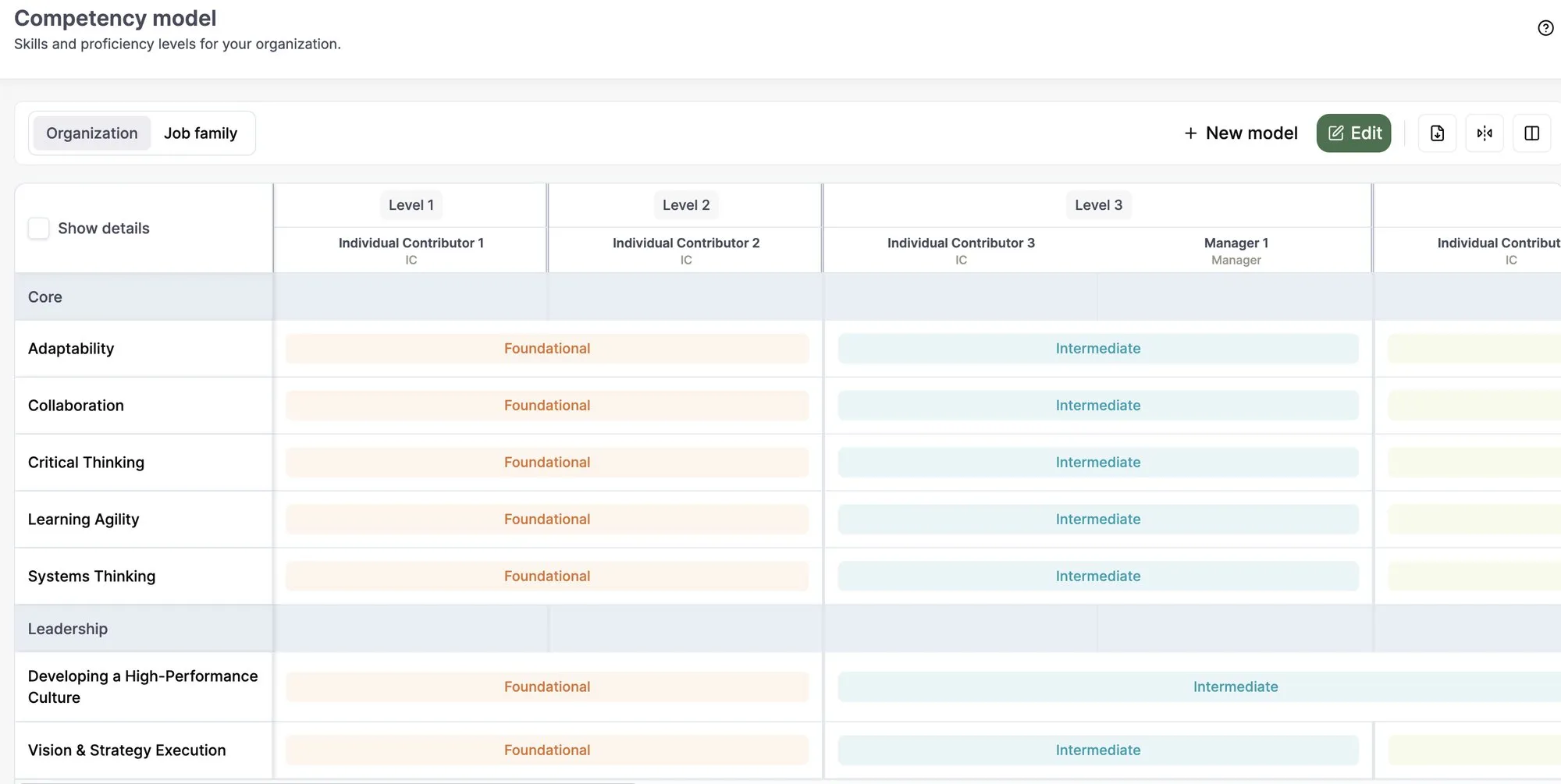
Keep your job architecture current as work changes
- Update roles and levels through a lightweight workflow — approvals, redlining, version history — instead of a time-consuming project that only gets updated every few years.
- Managers and employees work from the same live definitions rather than a document they never open.
- Explicit expectations at every level create organizational clarity and alignment.
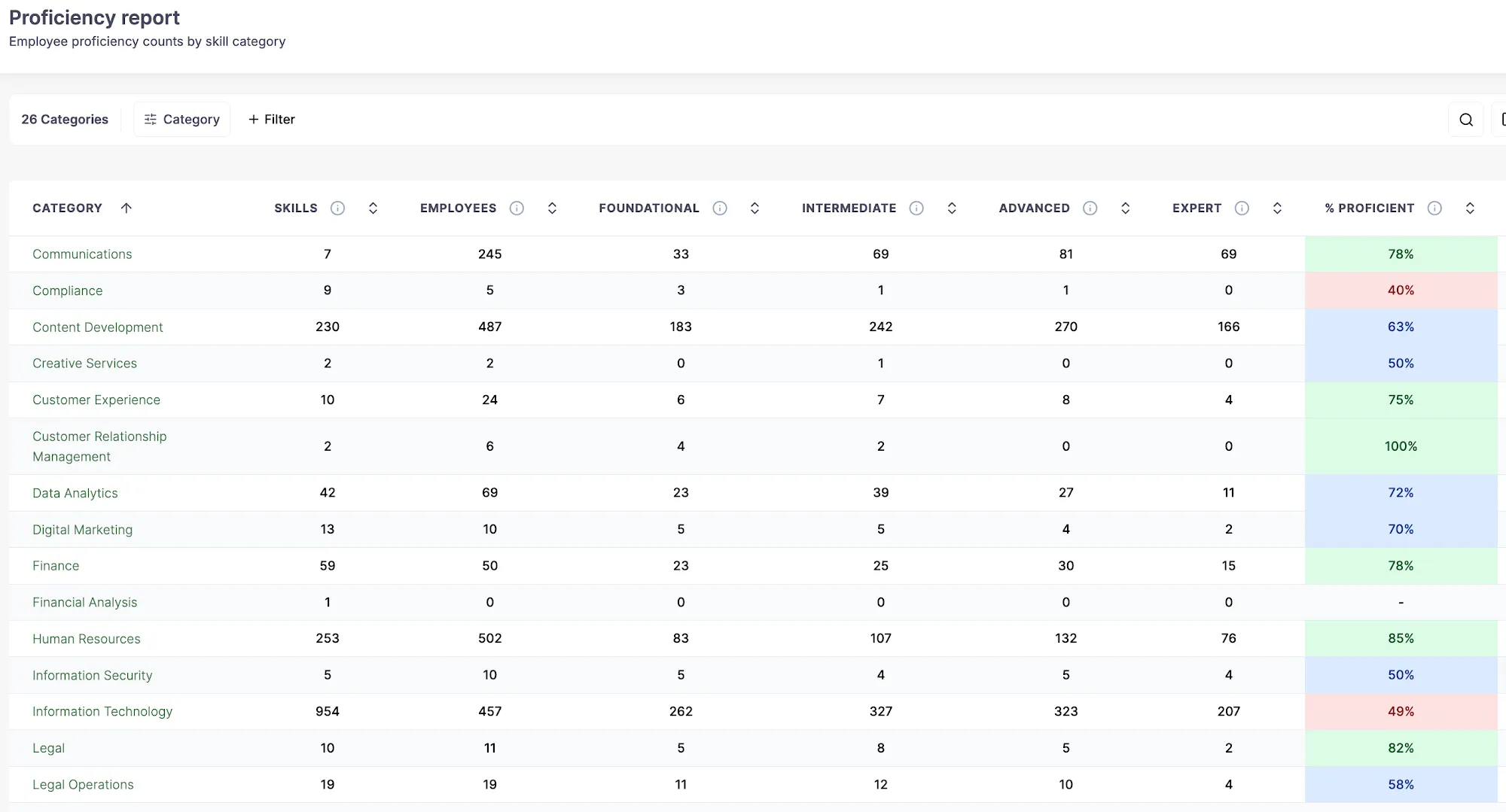
Identify skill gaps and emerging skills
- Skill depth reported by category, built for your industry and org structure, at a level your executive team will understand.
- Core, leadership, and AI skills roll up across functions, so capability reads by domain rather than role by role.
- Employees see the same proficiency data that drives their development plan.
Skill development in the flow of work.
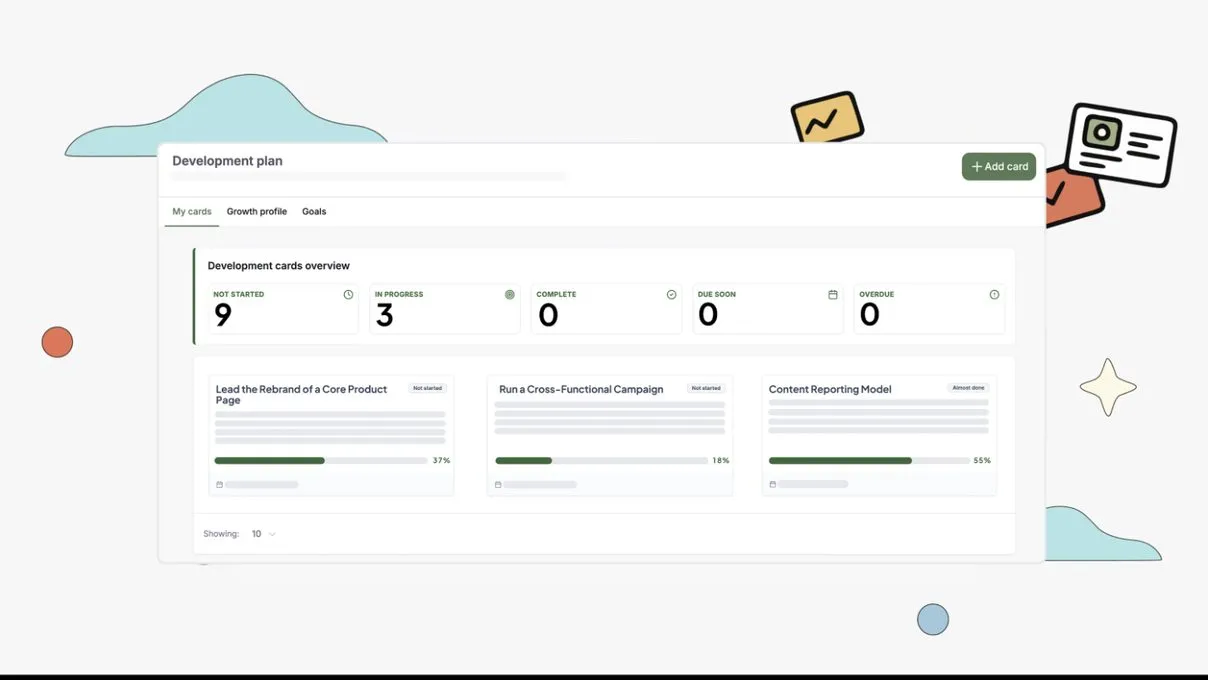
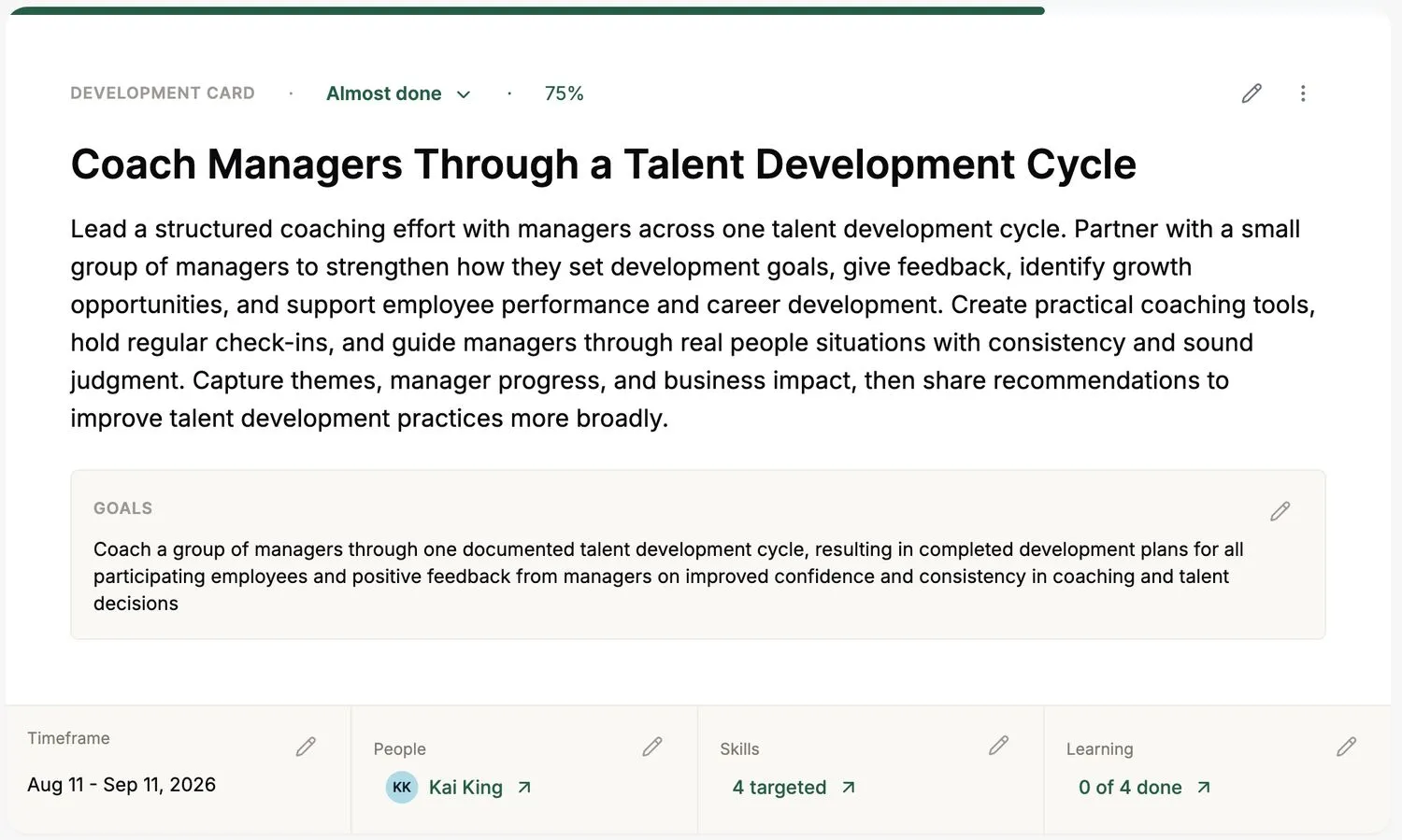
- Create development plans that help employees grow their skills in the flow of work and improve performance.
- Match employees with mentors who are advanced or expert for a specific skill
- Learning resources recommended from an open library of 50,000 courses, podcasts, books, and articles
- Track progress of every card, project, and resource — the employee, their manager, and HR see the same view.
Provide career path clarity
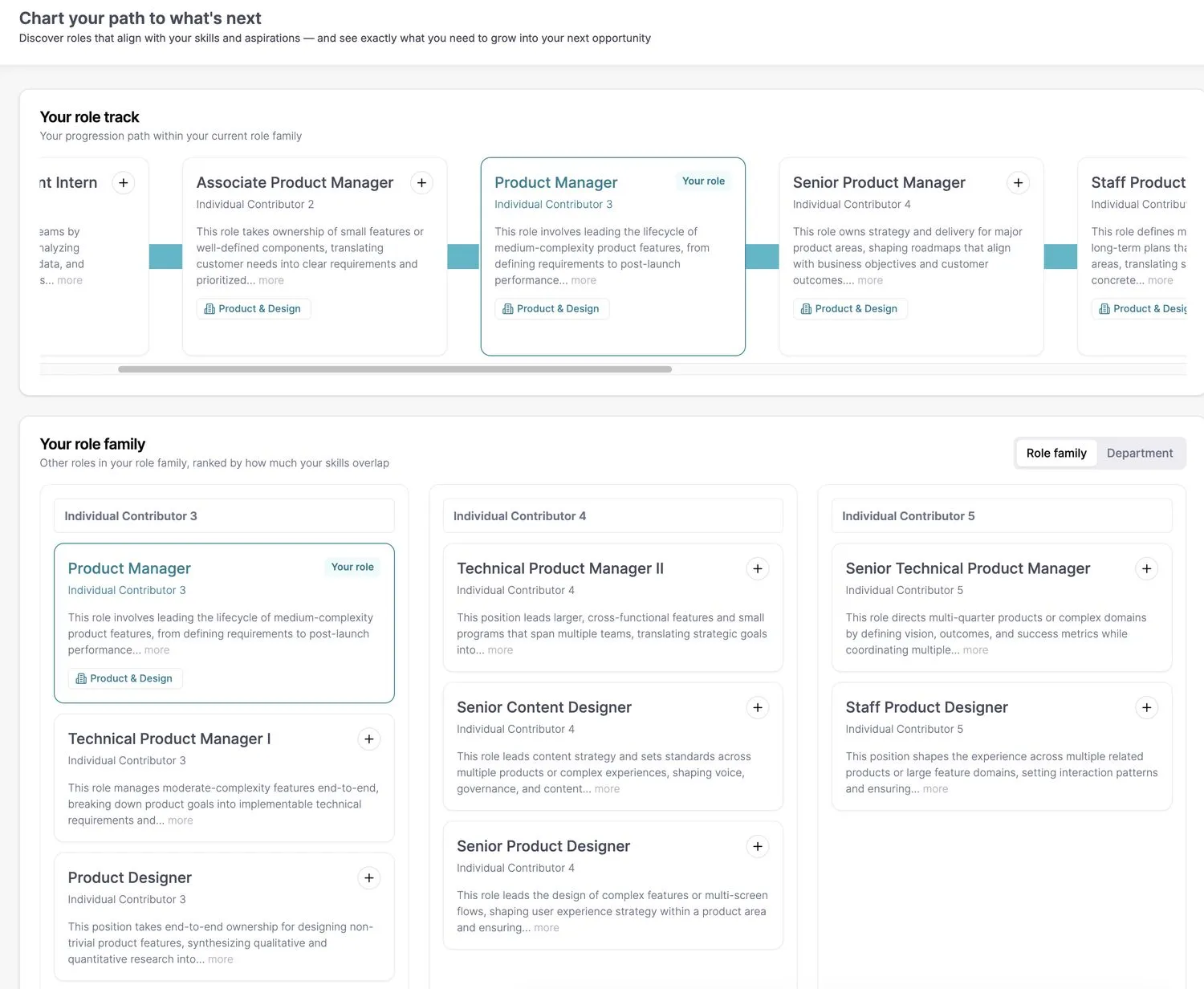
- Employees see roles in their track, job family, or department, from their level to two levels up.
- They can explore paths in other job families and departments, and track their readiness for each role.
- Once a target role is identified, a development plan can be created to build the skills that role requires.
- Fewer voluntary exits and more roles filled from within.
Skills-based career frameworks improve
employee and company performance.
Most organizations are not close to having one.
Fits the HR stack you already run.
Career Bird connects to your HRIS for employee data and shares job descriptions with your ATS, skills data with your LMS, and development plans with your performance management system. Your HRIS stays the system of record for people; Career Bird can serve as the system of record for roles and skills.








150+ more HR and payroll systems through the same connector
Employee data, handled the way HR expects.
Guides, templates, and research for building a career framework
All resources
Job architecture best practices
Role families, skills integration, governance, leveling and career path connection — what turns a static framework into a living one.
Read more
Skills gap analysis
The framework, the failure points, and how to connect findings to real talent development.
Read more
What Is Career Pathing?
The definition, why programs fail, and how to build one that works.
Read moreQuestions buyers ask
Can Career Bird build on the work we've already done?
Career Bird builds your job architecture from the job descriptions you already have, uploaded as Word documents or PDFs, so you do not start from a blank page. When a role has no existing job description, Career Bird generates a role description from the title, industry, and other inputs. Either way, the role's manager and HR review and approve every draft before it publishes. Correcting a draft is usually faster than writing from nothing. If you already have a leveling framework or a competency model, you use those as well.
How long does it take to stand up a job architecture?
Standing up a job architecture in Career Bird takes weeks rather than quarters, and the timeline depends almost entirely on how much review your team wants to do. The drafting is fast. What takes the time is the decision-making: agreeing on job families, settling how many levels there are, and approving role descriptions. The leveling system and competency model apply across the whole company, so they are settled once and every role is reviewed against the same standard.
Where do the skills in each role come from?
The skills for each role are suggested based on the responsibilities of that job. First, Career Bird reads the responsibilities in your existing job descriptions. Second, where a role has no job description, Career Bird generates a role description from the title, industry and other inputs. Third, the role's manager and HR review every description and the skills drawn from it, adding what is missing and removing what does not fit, before anything publishes. Skills come from one library and are reused across roles, so the same skill means the same thing in engineering as in finance.
What keeps the architecture current once it is live?
Career Bird keeps the architecture current after it goes live by updating roles through a workflow rather than a rebuild — approvals, redlining, and version history — so changing one role does not mean reopening the framework. When a job description changes, the role is re-drafted against the skills library your team has already approved, rather than against a blank sheet. When your team removes a skill from a role, that edit stays in place, and Career Bird does not substitute another skill for it.
Does Career Bird replace our HRIS or our ATS?
No, Career Bird does not replace your HRIS or your ATS. Your HRIS stays the system of record for people, and your ATS stays the system of record for open jobs and applicant tracking. Career Bird pushes job descriptions into it. Career Bird becomes the system of record for roles and skills, creating a single source of truth that stays up to date and keeps all departments in sync.
What if we already have an LMS or a performance management system?
If you already have an LMS or a performance management system, Career Bird integrates with it, sending skills data to the LMS and development plans to the performance management system. If you don't have one, or you are looking to consolidate, the Skill Development module and the learning resources library often meet the need on their own.
Couldn't we just do this with ChatGPT or Claude?
You could draft a single job description with ChatGPT, Claude or another general-purpose model. What you cannot do is keep hundreds of them consistent, reuse one skill definition across every role, route every change through approval, record who changed what and when, and show an employee the gap between their current proficiency and the bar for the next level. The drafting is the easy part. The workflow, governance and integration are the hard part.
Who is Career Bird built for?
Career Bird is built for mid-market companies with roughly 300 to 3,000 employees, specifically the Chief People Officer and their team, who own role clarity, skill development and career paths but have no team of consultants to build the framework. It is one integrated suite that ties together a system of record, insight, and action for HR, managers, and employees.
Build a career framework in 30 minutes from existing job descriptions.
Bring some of your current job descriptions. We'll build a draft job architecture from them on the call, with skills and levels for each role.