


Published July 1, 2026
Skills Taxonomy vs. Skills Ontology: What HR Leaders Actually Need
By · 1 min read
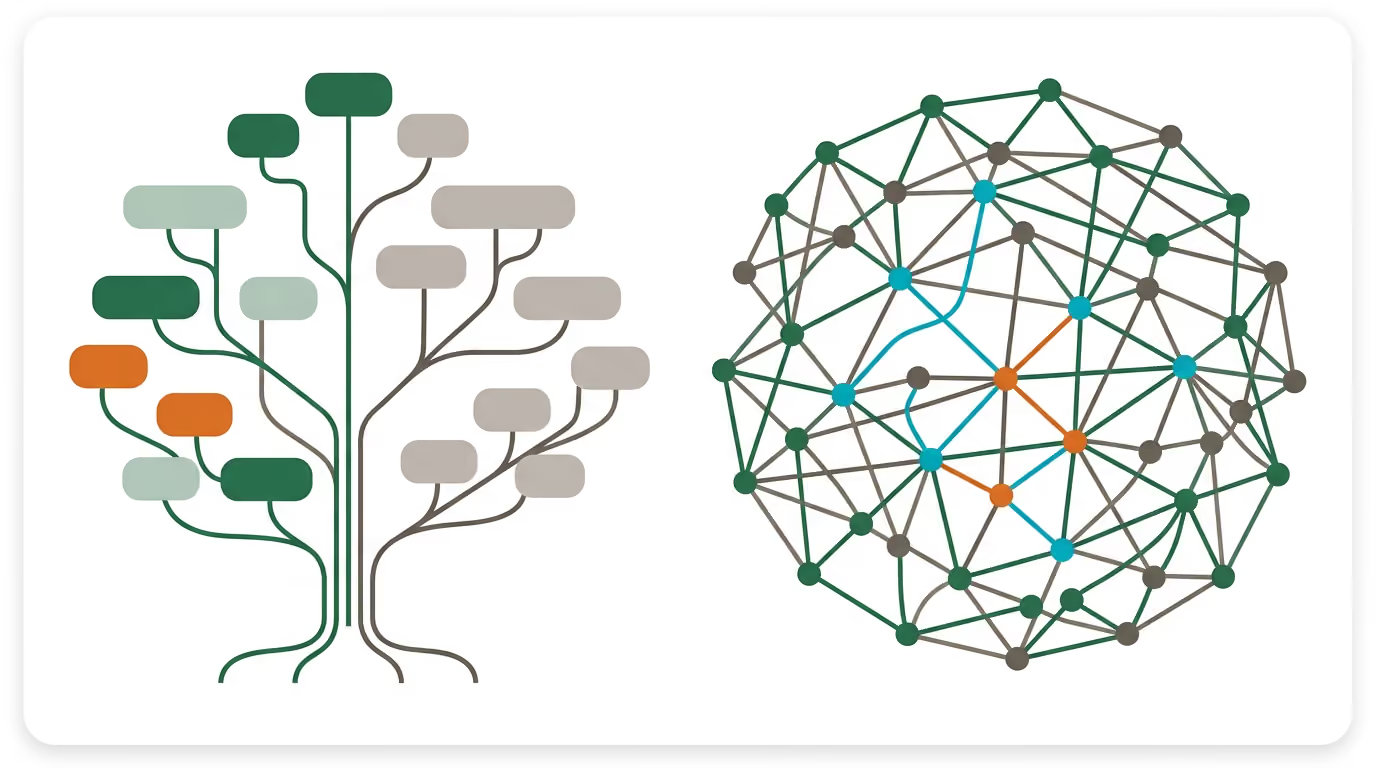
If you have spent time evaluating skills infrastructure vendors recently, you have almost certainly heard both terms. Skills taxonomy. Skills ontology. Sometimes used interchangeably. Sometimes positioned as competing approaches. Rarely defined with any precision.
This article cuts through that. Clear definitions, practical implications, and a direct answer to the question that matters most: what does a mid-market HR leader actually need?
What Is a Skills Taxonomy?
A skills taxonomy is a structured, hierarchical classification of skills organized into categories and subcategories. Think of it as an organized list: broad skill domains at the top (Data Analysis, Communication, Project Management), broken into more specific skills beneath them, sometimes broken down further into sub-skills or behavioral indicators.
Taxonomies are static by nature. They represent a snapshot of how skills are categorized at a point in time. An HR team builds or adopts one, maps it to their roles, and maintains it manually as the workforce and business evolve.
The primary value of a skills taxonomy is consistency. When everyone in your organization uses the same term for the same skill, you can compare proficiency levels across teams, identify gaps with confidence, and build career paths that reference shared language.
Without a shared taxonomy, you end up with what most mid-market organizations actually have: one team calling it "data visualization," another calling it "BI reporting," and a third listing it as "Tableau." Three labels for the same capability. Skills gap analysis becomes unreliable. Career path recommendations break down. Learning investments miss the mark.
What Is a Skills Ontology?
A skills ontology goes beyond classification. Where a taxonomy organizes skills into a hierarchy, an ontology maps how skills connect to other entities across your talent development ecosystem: roles, responsibilities, learning resources, and proficiency levels.
In an ontology, a skill belongs to a role, is related to a responsibility, is connected to specific learning resources, and has defined proficiency expectations. The value is in the connections between these entities, not just the categorization of skills themselves.
Where a taxonomy says "Python is a Programming Language skill," an ontology says "Python is required for the Data Engineer role at proficiency level 3, is connected to two internal learning paths and a certification program, and supports responsibilities including pipeline development and data transformation." The skill becomes actionable because it is linked to the structures your organization already operates.
Ontologies power the more practical features in skills platforms: role-based development plans, targeted learning recommendations, and career path mapping based on skill overlap between roles. When a platform tells you an employee is "60% of the way to a Data Engineer role," it is calculating that based on the ontology's mapped connections between the employee's current skills and the target role's requirements.
The complexity cuts both ways. Ontologies take significant effort to build, validate, and maintain. Commercial ontologies from vendors like Lightcast (formerly Emsi Burning Glass) or the World Economic Forum's Skills Taxonomy contain hundreds of thousands of skill nodes. That scale enables powerful matching logic. It also creates a real maintenance challenge when your organization needs to adapt it to your actual roles and context.
Why the Distinction Matters for Skills Mapping
Skills mapping is the practice of connecting skill requirements to roles, levels, and career paths across your organization. It is where taxonomy and ontology decisions have real operational consequences.
A taxonomy-based skills mapping approach says: here are the skills organized hierarchically for this role, and here are the proficiency levels expected at each grade. The output is a clean, auditable inventory of what skills exist and where they sit in your classification structure.
An ontology-based skills mapping approach says: here are the skills for this role, and here is how each one connects to learning paths, career moves, responsibilities, and proficiency expectations across your organization. The ontology makes skills actionable by linking them to the broader talent development ecosystem, so a skill gap is not just identified but connected to the learning resource that closes it, the responsibility it supports, and the career path it enables.
Both approaches are valid. The question is which one your organization can actually operate.
According to McKinsey, 87% of organizations either have skill gaps now or expect to face them within a few years. The problem is not awareness. The problem is building infrastructure to act on it. A skills framework that is technically sophisticated but operationally unmaintainable does not close those gaps.
The Vendor Trap: When Complexity Becomes a Liability
Here is the sales pitch you will hear from certain vendors: their platform is powered by a "dynamic, AI-inferred ontology" with 50,000 or 100,000 or 500,000 skill nodes, updated continuously from job postings and labor market data. Skills are inferred from job titles, automatically mapped to employees, and connected through thousands of relationship paths.
For a Fortune 500 company with a dedicated skills architecture team and a workforce of 50,000, that infrastructure has real value. For a 600-person professional services firm with a three-person HR team, it creates a different problem: an org-wide skills framework your team cannot validate, cannot explain to employees, and cannot maintain without the vendor.
It helps to understand how different vendors actually build their skills data, because the approach shapes the output your organization gets.
Skills inference is the method used by vendors like TechWolf and similar skills intelligence platforms. These systems analyze employee activity data from sources like GitHub, Slack, and email to infer what skills people have based on what they actually do. The advantage is a bottom-up, behavioral view of workforce capability. The risk is that inferred skills are only as accurate as the activity signals, and your HR team has limited ability to validate or correct the output at scale.
Labor market ingestion is the approach taken by Lightcast and similar data providers. These platforms ingest millions of job postings to understand what skills employers are listing for specific roles. The advantage is broad market intelligence. The limitation is that job posting language often reflects what companies think they want, not what actually drives performance in your specific organization.
The job-first approach starts from the other direction entirely: define the skills required for each role in your actual job architecture, then assess employees against those requirements. This is Career Bird's method. Rather than inferring skills from activity data or importing them from labor market signals, you build from the roles your organization actually has and the skills those roles actually require. For mid-market organizations, this tends to be the most operationally practical path because the skills framework is connected to your role structure from day one, not reverse-engineered from external data.
The specific failure mode with inference-first and market-first approaches looks like this. You get a dashboard full of data. But when a manager tries to have a career conversation with an employee, the skills listed do not match what that manager actually needs on the team. The "adjacent role" recommendation sends a Senior Analyst toward a Product Manager path that does not exist in your org structure. The skills data is real, but it is not connected to your actual roles, levels, and career paths.
Accuracy without connection is noise.
What Actually Matters for Mid-Market HR Leaders
The practical question is not taxonomy versus ontology. It is whether your skills framework meets three operational criteria.
1. Is it accurate enough to be actionable? The framework does not need to be perfect. It needs to be specific enough that employees recognize their roles in it, managers can use it for coaching conversations, and HR can identify meaningful skill gaps. IO psychology research consistently recommends 8 to 12 competencies per individual role profile (SIOP/SHRM, Workitect). Across a role family that spans multiple roles and seniority levels, that typically yields 50 to 200 unique validated skills — enough specificity for meaningful development planning without creating cognitive overload for employees or an unsustainable maintenance burden for HR.
2. Is it connected to your actual role structure? Skills data that floats free of your job architecture is not skills intelligence. It is a survey. The value comes when skill requirements are anchored to specific roles, at specific levels, so employees know exactly what they need to develop to move from a Senior Associate to a Manager in your organization's structure, not in some generic labor market model.
3. Can your team maintain it? Roles change. New technologies enter your tech stack. Skills that were differentiating three years ago are now baseline expectations. A skills framework your HR team cannot update without a vendor implementation engagement will drift from reality within 18 months.
Build, Buy, or Adopt a Pre-Built Framework?
Mid-market HR leaders typically face three options when building skills infrastructure.
Build your own taxonomy from scratch. This is how most organizations start: an HR leader or consultant identifies the skill domains relevant to the business, maps them to role families, and documents proficiency levels. The advantage is full customization. The cost is time (typically 6-12 months for a serious taxonomy build) and the ongoing maintenance burden. It also requires IO psychology expertise to get proficiency levels and behavioral anchors right.
License a commercial ontology or taxonomy. Companies like Lightcast and the World Economic Forum publish skills frameworks that organizations can license and adapt. These provide a strong foundation, particularly for role families with well-established skill profiles in the market. The adaptation work is still significant: you need to map the commercial framework to your specific roles and levels, validate it against your actual workforce, and maintain the mapping as your org evolves.
Adopt a vendor's pre-built, curated framework. Some skills platforms include a curated, IO-psychologist-validated skills framework as part of the product, designed to be connected directly to job architecture rather than maintained as a standalone taxonomy. The tradeoff is less customization flexibility in exchange for faster time-to-value and a framework designed to be operationally maintainable by an HR team without taxonomy-specialist expertise.
For most mid-market organizations, the third path has the best return on invested time. The goal is not to build the world's most sophisticated skills ontology. The goal is to build a skills-first talent development infrastructure that HR leaders can operate, managers can use, and employees actually engage with.
The Job Architecture Connection
A skills taxonomy, however well-constructed, delivers limited value without a job architecture to anchor it. Job architecture defines the role families, levels, and career paths in your organization. It answers the question: what roles exist, how do they relate to each other, and what does progression look like?
When skill requirements are mapped to specific roles at specific levels within a structured job architecture, three things become possible that were not possible before.
Employees can see exactly what skills they need to develop to move from their current role to their target role, inside your organization rather than in a generic market model. LinkedIn's 2023 Workplace Learning Report found that 75% of employees are more likely to stay when they have internal career mobility opportunities, and 68% would stay longer if offered more targeted learning and development. Skill-to-role clarity is what makes those mobility conversations real.
Managers can have development conversations grounded in specific, validated skill gaps rather than gut-feel assessments of readiness. The conversation shifts from "I think you need more leadership experience" to "here are the three skills you need to develop to be competitive for a Senior Manager role."
HR can identify organizational skill gaps at the aggregate level. Not just "we have a data science problem" but "we have a 40% proficiency gap in predictive modeling at the Senior Analyst level across our Analytics team, and here are the three roles most at risk." That specificity is what connects learning investment to business outcomes.
According to Deloitte research, companies taking a skills-first approach are 57% more likely to be agile. Agility does not come from having a sophisticated ontology. It comes from having skills data that is accurate, current, and connected to the decisions that drive business performance.
For a deeper look at building the role structure that makes skills intelligence work, see [how to build a job architecture framework].
What "Good Enough" Looks Like
Over-engineering is a real risk in skills infrastructure projects. Organizations spend 12 months building a comprehensive skills ontology, mapping thousands of relationships, and designing proficiency scales with five levels and twelve behavioral anchors per level. By the time it is ready, the business has changed, key stakeholders have turned over, and adoption is low because the framework feels abstract and disconnected from daily work.
Good enough for a mid-market organization looks like this:
- A curated set of skills mapped to each role family, with proficiency levels that are simple enough for managers and employees to understand without a reference guide
- Skill requirements defined at each grade level within your job architecture, so career progression has a clear skills-based rationale
- A mechanism for employees and managers to assess current proficiency, compare perspectives, and identify gaps
- A connection between identified skill gaps and available learning resources, so development plans are specific rather than generic
- Governance processes that allow HR to update the skills framework without a major project when roles or business needs change
That is a skills-first infrastructure. It does not require a 300,000-node ontology. It requires a framework that is accurate enough to be credible, connected enough to be actionable, and simple enough to be maintained by a real HR team with real constraints on time and resources. See our [skills gap analysis guide] for how to put that infrastructure to work.
FAQ: Skills Taxonomy and Skills Ontology
What is the difference between a skills taxonomy and a skills ontology?
A skills taxonomy is a hierarchical classification of skills organized into categories and subcategories. A skills ontology maps how skills connect to other entities in your talent ecosystem: roles, responsibilities, learning resources, and proficiency levels. Taxonomies organize skills into a structure. Ontologies show how skills relate to the broader systems your organization uses to develop and deploy talent. Both are useful; ontologies are more complex to build and maintain.
Does my organization need a skills ontology?
Most mid-market organizations do not need to build or maintain a custom skills ontology. What they need is a curated skills framework that is accurate for their role structure, connected to their job architecture, and maintainable by their HR team. Some vendors offer pre-built frameworks with ontology-like relationship mapping built in, which provides the analytical benefits without the maintenance burden.
How is skills mapping different from a skills taxonomy?
A skills taxonomy defines what skills exist and how they are categorized. Skills mapping is the process of connecting those skills to specific roles, levels, and career paths in your organization. The taxonomy provides the vocabulary. Skills mapping applies that vocabulary to your actual workforce structure. Both are necessary; neither delivers value without the other.
How many skills should be in a mid-market skills framework?
IO psychology research recommends 8 to 12 competencies per individual role. Across a full role family spanning multiple roles and levels, that typically yields 50 to 200 unique validated skills — comprehensive enough to be meaningful, simple enough to maintain. Start with a curated, validated set and expand based on demonstrated organizational need.
Should skills be defined by HR or by the business?
Both. HR and IO psychology expertise is needed to validate proficiency levels, ensure consistency across role families, and design behavioral anchors that are measurable rather than subjective. Business and functional leaders need to validate that the skills in the framework reflect what actually drives performance in their teams. A skills framework built by HR alone risks being theoretically sound but operationally disconnected. Built by business leaders alone, it risks inconsistency and structural gaps.
If you are evaluating whether your current skills infrastructure is connected to your job architecture in a way that makes career pathing and learning investment actionable, Career Bird's platform ties a curated, IO-psychologist-validated skills framework directly to role structure, proficiency assessment, and career pathing. Per-seat pricing starts at $4/month, with 150+ HRIS integrations and no six-figure implementation.